Four simple rules. Infinite complexity.
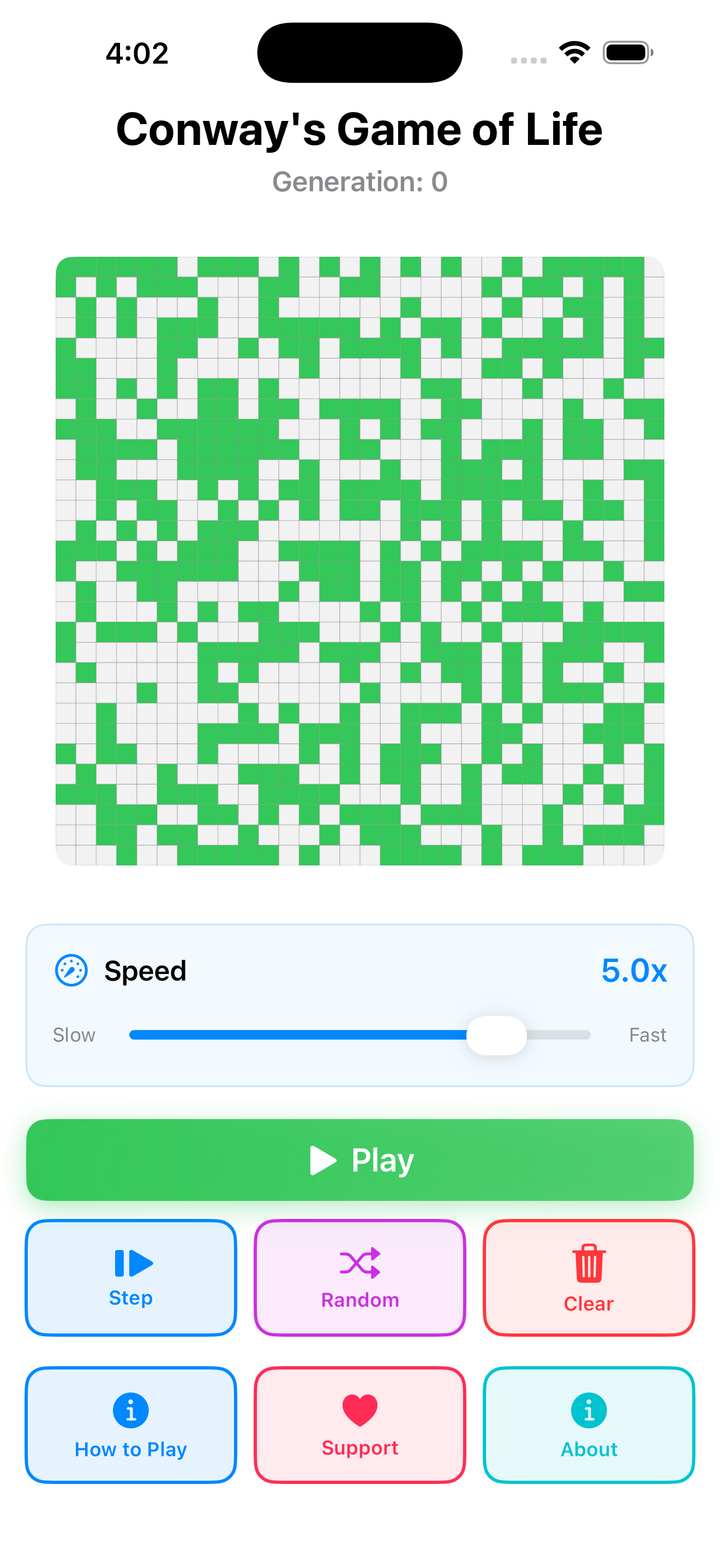
Conway's Game of Life on iPhone and iPad. Draw cells, press play, and watch gliders, oscillators, and still lifes emerge from the grid.
Conway's Game of Life on iPhone and iPad. Draw cells, press play, and watch gliders, oscillators, and still lifes emerge from the grid.
Start with intention or start with chaos. Either way, the rules do the rest.
Tap and drag on the grid to place living cells exactly where you want them. Design your own starting patterns with precision.
Hit Random to fill the grid with a chaotic starting state and watch surprising structures emerge from the noise.
A clean, focused tool for exploring emergent behavior.
Control the simulation from slow and deliberate to fast and chaotic.
Advance one generation at a time to study exactly how each cell lives, dies, or is born.
Record your simulations and share them with friends or on social media.
Personalize your grid. Your selection is saved between sessions.
A clean, focused experience with no interruptions.
No account, no analytics, no tracking. All grid data stays on your device.
Four simple rules govern every cell, every generation. Out of them: gliders, oscillators, and infinite complexity.
A living cell with fewer than 2 living neighbors dies.
A living cell with 2 or 3 living neighbors lives on.
A living cell with more than 3 living neighbors dies.
A dead cell with exactly 3 living neighbors becomes alive.
From simple seeds, fascinating life forms emerge.
Small patterns that travel diagonally across the grid, seemingly alive.
Blinkers, toads, and beacons that cycle between states endlessly.
Stable patterns that remain unchanged generation after generation.
Random starting states that evolve into unpredictable, mesmerizing complexity.
A clean grid, intuitive controls, and patterns coming to life.

Explore the foundations of cellular automata and emergent behavior.
Learn about computation, mathematical patterns, and complex systems.
Watch mesmerizing patterns unfold for a calming, meditative experience.
Conway's Game of Life is a cellular automaton invented by mathematician John Conway in 1970. Cells live on a grid and follow four simple rules — underpopulation, survival, overpopulation, reproduction — that produce surprisingly complex emergent behavior, including moving "gliders", oscillating patterns, and stable "still lifes".
1) Underpopulation: a living cell with fewer than 2 living neighbors dies. 2) Survival: a living cell with 2 or 3 living neighbors lives on. 3) Overpopulation: a living cell with more than 3 living neighbors dies. 4) Reproduction: a dead cell with exactly 3 living neighbors becomes alive.
Use Draw Mode to tap or drag on the grid and place living cells exactly where you want. Use Random Mode to fill the grid with a chaotic starting state. Press Play to run the simulation, or step through one generation at a time.
No. There is no account, no analytics, no tracking. All grid data stays on the device. Apple handles payment data for any optional donations.
iPhone and iPad running iOS 17 or later.
Your data stays on your device. No account required, no analytics, no tracking. All game data remains local.
Apple handles payment data for any optional donations made through the App Store. We never see or store payment information.
The app uses no third-party SDKs, no advertising networks, and no usage telemetry of any kind.
By downloading or using this app, you agree to use it for personal, non-commercial purposes.
The app is provided "as is" without warranties of any kind. Use it at your own discretion.
All app content — design, code, and graphics — is the property of Sylvain Lafrance. You may not copy, modify, distribute, or reverse-engineer any part of the app.
Questions, feedback, or a pattern you'd love to see featured? I'd love to hear from you.
Contact meUsually a reply within 1–2 business days.