The Golden Age of Shareware: How "Try Before You Buy" Built an Industry on Trust
Before app stores and digital downloads, there was shareware — a revolutionary distribution model that taught the software industry to trust its customers.
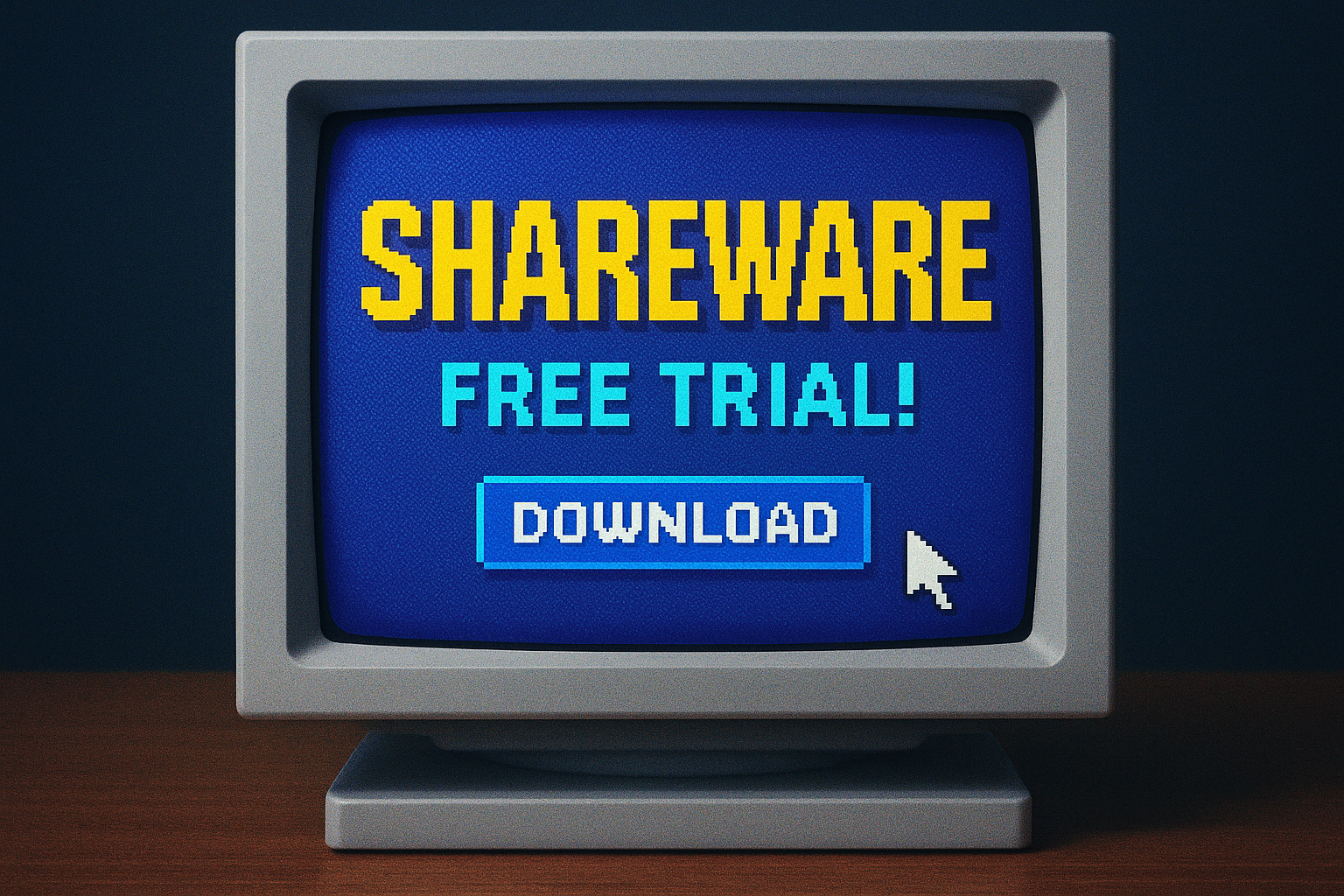
Before app stores, before digital downloads, before the internet as we know it, there was shareware — a revolutionary distribution model that democratized software development and gave birth to some of the most beloved games and applications of the personal computer era.
What was shareware?
Shareware was elegantly simple: developers distributed their software freely, allowing users to try it before deciding whether to purchase a full version or registration. Unlike freeware (completely free) or commercial software (sold in boxes at stores), shareware operated on an honor system that reflected the early computing community's idealism and trust.
The typical shareware model worked like this: you'd receive a functional version of the program, often with some limitations — maybe the first few levels of a game, reduced features, or frequent registration reminders. If you liked it, you'd mail a check to the developer, who would send you the full version, a printed manual, and sometimes bonus content or technical support.
The perfect storm of circumstances
Several factors converged in the 1980s to make shareware viable. The personal computer revolution was underway, with machines like the Apple II, Commodore 64, and IBM PC finding their way into homes and small businesses. Yet commercial software was expensive, often costing $50 to $100 or more — substantial money in 1980s dollars.
Distribution was another key factor. Bulletin Board Systems (BBS) emerged as digital gathering places where users could dial in with modems and download files. Computer user groups held regular meetings where members swapped floppy disks. These grassroots distribution channels cost developers almost nothing, bypassing the expensive retail distribution system that traditionally gave publishers their stranglehold on the industry.
The pioneers
Bob Wallace coined the term "shareware" in 1983 with his word processor PC-Write, but the concept had earlier roots. Andrew Fluegelman's PC-Talk communication program (1982) used what he called "freeware" — though his definition meant something closer to what we'd call shareware today.
The model truly exploded with games. Scott Miller's Apogee Software pioneered the "episodic" approach with games like Kingdom of Kroz and Beyond the Titanic, offering the first episode free and charging for subsequent installments. This strategy would later birth Commander Keen and Duke Nukem, making Apogee a shareware powerhouse.
Jim Knopf's PC-File database program demonstrated that business software could thrive under the shareware model. His company, ButtonWare, proved that treating customers with respect and offering genuine value could build a sustainable business without traditional marketing or retail presence.
The culture and community
Shareware wasn't just a business model — it was a philosophy. Many developers included personal notes in their documentation, sharing their stories and motivations. Registration often felt like joining a club rather than merely purchasing a product. Some developers became celebrities within the community, known for their responsiveness to user feedback and their willingness to engage directly with their audience.
The Association of Shareware Professionals, founded in 1987, attempted to codify standards and protect the shareware brand from those who abused the honor system or misrepresented their products. The organization helped legitimize shareware in the eyes of both users and the press.
Why it worked
The shareware model succeeded because it aligned incentives beautifully. Users got to evaluate software risk-free before spending money — crucial when a bad purchase meant wasting a significant sum. Developers received direct feedback from users and captured revenue they might never have seen through traditional channels. The low barrier to entry meant talented programmers could reach audiences regardless of their business connections or capital.
The honor system worked better than cynics might have predicted. While piracy certainly existed, enough users paid to make shareware viable for hundreds of developers. Many users reported feeling a genuine obligation to register software they used regularly, and some even paid for programs they'd stopped using, simply to support developers they respected.
25 notable shareware programs of the 1980s
These titles represented the cream of the shareware crop, distributed through BBS systems, user groups, and mail-order shareware catalogs. Many users' first experience with shareware came through one of these, often copied from a friend's floppy disk or downloaded over a 1200-baud modem connection.
-
1982
PC-Talk
Andrew Fluegelman's pioneering terminal emulator and communications program — the first to call itself "freeware" in something close to the shareware sense.
-
1982
PC-File
Jim Knopf's database management system from ButtonWare — proof that business software could thrive on the honor system.
-
1983
PC-Write
Bob Wallace's full-featured word processor — the title that coined the word "shareware."
-
1983
PC-Calc
ButtonWare's spreadsheet program — a credible alternative to Lotus 1-2-3 at a fraction of the price.
-
1983
LIST
Vernon Buerg's lightning-fast file viewer — a tiny utility that became a permanent fixture on DOS machines.
-
1984
Qmodem
John Friel's terminal program that became the de facto standard for BBS communication.
-
1984
NewKey
Frank Bell's keyboard macro program for automating repetitive DOS tasks.
-
1984
PC-Outline
Brown Bag Software's outlining tool for organizing thoughts and writing.
-
1984
Sidekick
Borland's memory-resident desktop organizer, initially distributed as shareware before becoming a commercial hit.
-
1985
ProComm
An essential communications program that rivaled Qmodem on the BBS scene.
-
1985
PC-Deskteam
Abacus Software's desktop organizer suite — calendar, calculator, and notes in one TSR.
-
1985
Automenu
Marshall Magee's menu system for DOS — a friendly front-end before Windows took over.
-
1985
MegaEdit
A powerful programmer's text editor in the days before Visual Studio existed.
-
1985
PC-Browse
A database viewer for dBASE files that made data exploration approachable.
-
1985
TickleX
A calendar and reminder program — the proto-todo-app of its era.
-
1986
TheDraw
Ian Davis's ANSI art editor, beloved by BBS sysops for crafting login screens.
-
1986
Telix
Colin Sampaleanu's terminal emulator with scripting support — power-user catnip.
-
1986
As-Easy-As
TRIUS Inc.'s Lotus 1-2-3-compatible spreadsheet, free to try and cheap to register.
-
1987
Kingdom of Kroz
Apogee's ASCII-based adventure game — the proving ground for episodic shareware gaming.
-
1987
EGA Paint
An early graphics program for the EGA display standard.
-
1987
Nyet
Andrey Smirnov's Tetris clone — spread rapidly through BBS networks worldwide.
-
1987
Wheel of Fortune
ShareData's adaptation of the iconic TV game show.
-
1988
Ruby Volume I–III
Apogee's puzzle-adventure series, released across 1988–1989 as separate registered volumes.
-
1989
PKZip
Phil Katz's revolutionary file compression utility — the format that became universal.
-
1990
Commander Keen
id Software's platform game that revolutionized PC gaming, with late-'80s roots in the shareware tradition.
Together, these programs demonstrated that shareware could deliver quality software across every category — from utilities to games to business applications.
The legacy
By the early 1990s, shareware had proven that alternative distribution models could work. The industry produced classics like Wolfenstein 3D, DOOM, and Civilization — titles that helped define their genres. Business applications like WinZip and Paint Shop Pro became indispensable tools for millions.
While the rise of the internet and digital marketplaces has transformed software distribution, shareware's DNA persists in modern practices: free trials, freemium models, early access programs, and indie game distribution all echo the principles established by those pioneering developers of the 1980s.
The shareware era represented something special — a moment when the personal computer industry was still small enough that individual developers could make meaningful connections with their users, and idealistic enough that many people on both sides of the transaction believed in doing the right thing.
It was the try-before-you-buy model that taught an industry you could trust your customers — and more often than not, they'd trust you back.
Get in touch.
Remember a shareware program I missed? Have a registration story from back then? I'd love to hear from you.
Contact meI usually reply within 1–2 business days.